Kitchen Tool Guides
Types of Blenders Explained: From the First Blender to the Immersion Blender
From the first electric blender to the immersion blender — a clear guide to the main types of blenders, and which one is actually the most useful in a home kitchen.
As an Amazon Associate, Geomorpho Studios earns from qualifying purchases — at no extra cost to you.
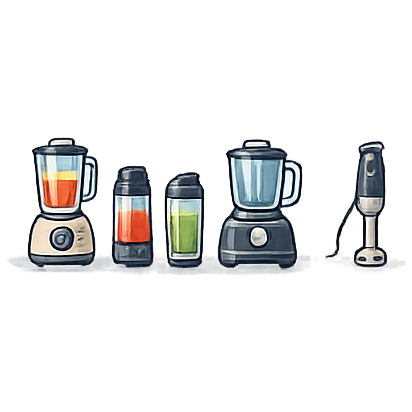
Blenders seem simple enough: a motor, a blade and something to hold the food.
But over the last century, that basic idea has evolved into several surprisingly different kitchen appliances. There are traditional countertop blenders, high-performance machines, personal smoothie blenders, portable rechargeable models and immersion blenders that don’t require a pitcher at all.
So, what are the different types of blenders, and which blender is actually the most useful in a home kitchen?
To answer that properly, it helps to go back to a time when a “blender” wasn’t an appliance at all.
Types of blenders at a glance
| Blender type | Best for | Main limitation |
|---|---|---|
| Countertop | Smoothies, ice and larger batches | Storage and cleanup |
| High-performance | Tough ingredients and extremely smooth results | Price, noise and size |
| Personal | Individual smoothies and shakes | Small capacity |
| Portable | Work and travel | Limited power |
| Commercial | Frequent heavy use | Excessive for most homes |
| Immersion | Soups, sauces and small jobs | Not suitable for most ice-crushing |
Before Blenders: How Did People Purée Food?
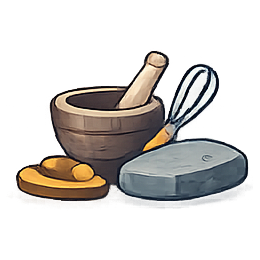
Humans were blending, crushing and puréeing food thousands of years before anyone plugged an appliance into a wall.
The original “blenders” were our hands and a collection of simple tools.
Mortars and pestles crushed herbs, spices and nuts. Grinding stones pulverized grains. Wooden spoons and mashers broke down cooked vegetables. Whisks combined liquids and incorporated air.
For an especially smooth soup or sauce, cooks could force cooked ingredients through a sieve. Later, mechanical food mills made puréeing easier by forcing soft food through a perforated plate.
These methods could produce excellent results. What they couldn’t provide was speed.
A modern blender can accomplish in seconds what once required repeated crushing, mashing, stirring and straining. And that helps explain why the electric blender was such a significant kitchen invention.
The First Electric Blenders Changed Everything
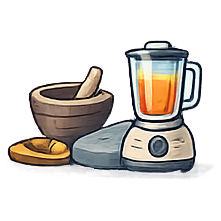
The earliest electric blenders weren’t originally created because people desperately needed an easier way to make butternut squash soup. They were closely connected to drinks.
During the 1920s, inventor Stephen Poplawski developed a machine that used a motor-driven blade at the bottom of a container to mix beverages.
It established the basic arrangement that remains instantly recognizable today: container on top, spinning blade in the bottom, electric motor underneath.
As blender designs improved and entered more homes, their usefulness expanded far beyond drinks. Suddenly a machine could turn cooked vegetables into soup, fruit into purée and ingredients into sauces with the push of a button.
The basic countertop blender had arrived.
How the Blender Changed Home Cooking
Through the middle decades of the twentieth century, small electric appliances increasingly took over jobs previously performed by hand.
The blender was particularly useful because it didn’t merely make an existing technique faster. It made smooth textures much easier to achieve at home.
Soups and purées, sauces and dressings, milkshakes, batters and baby food all became far easier to make at home. Over time, however, one blender design began branching into several — which is why walking into an appliance department today can be surprisingly confusing.
What Are the Different Types of Blenders?
There isn’t one universally agreed number of blender types because some categories overlap. But for home cooks, the useful distinction is between countertop, high-performance, personal, portable and immersion blenders. Commercial blenders form another category primarily intended for professional use.
Each solves a slightly different problem.
1. Countertop Blenders: The Traditional All-Rounder
This is the blender most of us picture when someone says “blender.”
A countertop blender consists of a motorized base and a removable pitcher containing blades. The shape of the pitcher helps circulate ingredients toward those blades while the machine runs.
Our pickCountertop blender
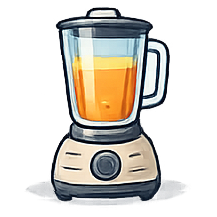
What is a countertop blender best for?
Countertop blenders are particularly good for:
- smoothies
- milkshakes
- frozen drinks
- crushed ice
- fruit purées
- larger quantities of liquid
- smooth soups
Their biggest advantage is power and consistency. Give a good countertop blender enough time and liquid and it can produce exceptionally smooth results.
The downside
The pitcher is also the countertop blender’s greatest inconvenience. It has to be stored somewhere, washed after use and filled before anything can be blended.
That isn’t a major problem when you’re making a pitcher of smoothies. It’s considerably more annoying when the food you want to blend is already sitting in a large cooking pot.
2. High-Performance Blenders: More Power, Finer Results
A high-performance blender is essentially the countertop blender taken to its logical extreme.
Powerful motors and carefully designed containers allow these machines to process ingredients ordinary blenders may struggle with.
Our pickHigh-performance blender
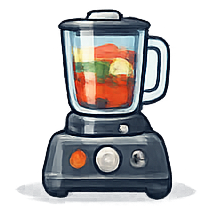
They’re especially useful for:
- very smooth smoothies
- frozen fruit
- nut butters
- thick dips
- seeds
- fibrous vegetables
- large batches
If achieving an extremely fine texture is important to you, this is where a powerful full-size blender has a clear advantage. The trade-offs are equally obvious: size, noise, cost and cleanup.
For someone who makes frozen smoothies every morning, those compromises may be worthwhile. For someone who occasionally wants to purée a pot of soup, they’re harder to justify.
3. Personal Blenders: The Smoothie Blender Shrunk Down
The personal blender changed the question from “How do we make a better blender?” to “What if you’re only making one drink?”
Instead of a large pitcher, personal blenders generally use smaller blending cups suitable for one or two servings. Many cups can also become the drinking container once blending is finished.
Our pickPersonal blender
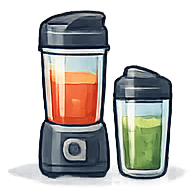
They’re compact and convenient, particularly for people whose main reason for owning a blender is making smoothies. But their small capacity is precisely what makes them less useful for general cooking.
A personal blender isn’t what you want when there’s a large pot of soup sitting on the stove.
4. Portable Blenders: Blending Without an Outlet
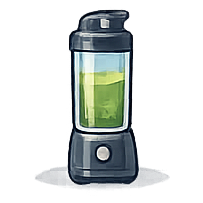
Rechargeable batteries eventually created another category: the portable blender. These compact machines are intended to go places traditional blenders can’t.
That can make them convenient for work, travel, camping or anywhere a power outlet isn’t readily available.
Portability, however, requires compromise. A small battery-powered appliance generally isn’t the tool you’d choose for repeatedly processing large amounts of ice, frozen ingredients or thick mixtures.
Its defining feature isn’t maximum blending ability. It’s the ability to blend somewhere else.
Our pickPortable blender
5. Commercial Blenders: Built for Repetition
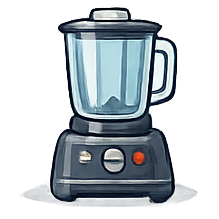
A blender in a restaurant or smoothie shop may perform the same basic job dozens or even hundreds of times in a day. Commercial machines are therefore designed around demanding workloads.
Depending on the model, that can mean powerful motors, durable components, large containers and controls designed for repeated use.
They’re important to the history and development of blenders, but they’re usually unnecessary in a normal home kitchen.
Our pickCommercial-grade blender
6. The Immersion Blender: A Completely Different Approach
In 1950, Swiss inventor Roger Perrinjaquet applied for a patent for a portable kitchen appliance that became the basis of the immersion blender. The appliance became known as the Bamix, a name derived from French words meaning to beat and mix.
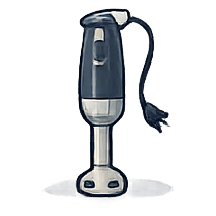
Instead of placing a motor underneath a pitcher, an immersion blender places a small blade at the end of a handheld shaft. The cook lowers that shaft directly into the food.
For decades the assumption was that food went into the blender. Then someone reversed it: carry the blade to the food. It’s a deceptively important change, because for the first time the blender no longer needs its own blending container.
Your saucepan can be the blender container. So can your stockpot. Or a bowl. Or a tall measuring jug.
That’s why immersion blenders are also commonly called hand blenders, stick blenders or wand blenders.
Our pickImmersion blender
Immersion Blender vs. Regular Blender: What’s the Difference?
The fundamental difference is remarkably simple:
Countertop blender
You bring the food to the blender.
Immersion blender
You bring the blender to the food.
That changes the experience considerably.
| Task | Countertop Blender | Immersion Blender |
|---|---|---|
| Frozen smoothies | Excellent | Limited |
| Crushing ice | Excellent | Poor |
| Silky-smooth purées | Excellent | Very good |
| Soup in the cooking pot | Requires transfer | Excellent |
| Sauces | Excellent | Excellent |
| Salad dressings | Excellent | Excellent |
| Mayonnaise | Good | Excellent |
| Small quantities | Sometimes awkward | Excellent |
| Large quantities of soup | Usually requires batches | Excellent |
| Storage | Requires cupboard/counter space | Usually compact |
| Cleanup | Pitcher, lid and blade area | Usually just blending shaft |
| Use directly in cookware | No | Yes |
Neither design completely replaces the other. A countertop blender wins when maximum power and smoothness matter. An immersion blender wins when convenience and direct-in-the-pot blending matter.
What Is an Immersion Blender Used For?
An immersion blender is much more versatile than its appearance suggests. It’s particularly useful for:
- soups and sauces
- gravies and dressings
- mayonnaise and emulsions
- small purées and baby food
Some immersion blenders also include whisk or chopping attachments, although those aren’t necessary to appreciate the basic tool.
Its greatest trick remains the simplest one: put it directly into what you’re already cooking.
Why an Immersion Blender Is So Good for Soup
Soup may be the immersion blender’s ideal job. A countertop blender often means letting the pot cool, transferring it and blending in batches. An immersion blender goes straight into the cooking pot, removing most of that handling and cleanup.
It also lets you stop the moment the soup reaches the texture you want, rather than blending everything to a uniform purée. For soups and sauces, convenience rather than raw motor power is often what matters most.
Which Type of Blender Should You Choose?
The easiest way to decide is to ignore specifications for a moment and think about what you actually make.
- Choose a countertop blender if: you frequently make smoothies, frozen drinks, crushed ice or large quantities where maximum smoothness matters.
- Choose a high-performance blender if: you blend frequently and want enough power for tough ingredients, very smooth textures, nut butters and demanding jobs.
- Choose a personal blender if: your main priority is making one smoothie or shake at a time.
- Choose a portable blender if: being able to blend away from your kitchen matters more than maximum power.
- Choose a commercial blender if: you need a machine built for frequent, heavy use rather than ordinary home cooking.
- Choose an immersion blender if: you cook soups, sauces and everyday meals and value fast cleanup, compact storage and the ability to blend directly in the cooking pot.
And if you already own a countertop blender? An immersion blender can still be worth having because the two tools solve different problems.
Why We Think an Immersion Blender Belongs in Almost Every Kitchen
An immersion blender won’t replace a powerful countertop blender for crushing ice, frozen smoothies or the smoothest possible results. But for soups, sauces, purées and smaller everyday jobs, it is often the more convenient tool.
It is compact, quick to clean and blends food directly in the container you are already using. And sometimes the best kitchen tool isn’t the one that can do the most. It’s the one that makes you do less.
Blender questions, answered
What are the main types of blenders?
For home cooks the main types are countertop, high-performance, personal and portable blenders, plus the immersion (hand) blender. Commercial blenders are a separate category built for heavy professional use.
What is the difference between an immersion blender and a regular blender?
With a countertop (regular) blender you bring the food to the blender; with an immersion blender you bring the blender to the food and blend directly in the pot. Countertop blenders win on power, crushing ice and ultra-smooth smoothies, while immersion blenders win on soups, sauces and convenience.
Can an immersion blender replace a countertop blender?
For everyday soups, sauces, dressings and small purées an immersion blender can handle a surprisingly large share of the work. But if you regularly crush ice, blend frozen fruit or want exceptionally smooth smoothies, a countertop blender is still the better machine.
What is an immersion blender used for?
Soups, sauces, gravies, salad dressings, mayonnaise and other emulsions, small purées and baby food — blended directly in the saucepan, pot, bowl or measuring jug you are already using.
Who invented the immersion blender?
Swiss inventor Roger Perrinjaquet applied for a patent for the handheld appliance in 1950. It became known as the Bamix, a name derived from the French for to beat and mix.
Is a hand blender the same as an immersion blender?
Yes. Hand blender, stick blender and wand blender are all common names for the same tool — an immersion blender, with the motor in the handle and a small blade on the end of a shaft that you lower directly into the food.
Can you use an immersion blender directly in hot soup?
Yes — that is one of its main advantages. You can blend soup right in the pot. Keep the blade fully submerged before switching it on to avoid splashing hot liquid, and follow the manufacturer’s guidance on maximum temperatures and continuous run time.
Sources & further reading

Plan dinners the easy way with Dinner123
Browse recipes, plan your meals and build your grocery list automatically.
Explore Dinner123Coming soon for Android and iPhone.